
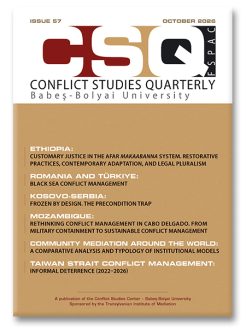
Issue 57 – October 2026
TOPICS: Restorative justice, Conflict management, Community mediation, Black Sea, Kosovo-Serbia
Coordinator:
Christian Chereji and Ciprian Sandu
Content – Sommaire:

ARTICLES in Issue 57 – October 2026:
Ethiopia: Customary Justice in the Afar Makaabanna System. Restorative Practices, Contemporary Adaptation, and Legal Pluralism
Ahmed Humed ABDELLA, Ediga VENKATESU
Abstract:
The Makaabanna is an Indigenous customary justice institution through which Afar elders interpret Mad’a, mediate disputes, negotiate responsibility, and restore relationships through compensation and reconciliation. This article examines how the Makaabanna classifies harm, applies restorative remedies, adapts to contemporary disputes, and operates alongside Ethiopia’s formal legal institutions. It draws on fieldwork conducted from August 2024 to January 2025, comprising 57 key-informant interviews, six focus group discussions with 36 participants, six nonparticipant observations across six zones, and documentary and archival analysis. Method-specific figures are reported separately because the study did not document potential overlap across methods. We analyzed qualitative materials thematically through iterative coding, comparison, and triangulation. Findings show a structured approach to homicide, bodily injury, defamation, unlawful restraint, sexual and family-related harm, property disputes, road accidents, and mobile-money fraud. The strengths of the Makaabanna include accessibility, negotiated responsibility, retaliation prevention, and relationship restoration. Its limitations include variable compensation, incomplete documentation, uncertain jurisdiction in serious criminal matters, uneven coordination with courts and police, and limited technical capacity to address modern offenses. The Makaabanna functions as a semi-autonomous normative order whose social recognition exceeds its procedural integration with state institutions. Sustainable reform requires referral arrangements, documentation, participation by affected persons, and cooperation that preserves its restorative strengths while maintaining state responsibility for public law offenses.
Keywords:
Customary justice, Ethiopia, indigenous law, legal pluralism, Makaabanna, restorative justice.
DOI: https://doi.org/10.24193/csq.57.1
Romania and Türkiye: Black Sea Conflict Management
Pınar Buket KILINÇ PALA
Abstract:
This study examines the management of conflict spillovers in the Black Sea region by Romania and Türkiye, with a particular focus on energy governance as a domain in which distinct conflict management strategies are evident and analytically comparable. The Black Sea has emerged as a zone of complex, multilevel conflict characterized by geopolitical confrontation, territorial disputes, and infrastructural vulnerability, generating cascading spillovers that affect the governance systems of coastal states. This article posits that state responses to these pressures represent significant instances of conflict management, mediation, and adaptive governance rather than merely technical adjustments. Understanding these responses necessitates analytical frameworks derived from conflict analysis, mediation theory, and alternative dispute resolution (ADR) literature. This study develops a three-dimensional analytical framework encompassing conflict spillover management, institutional filtering, and adaptive conflict response. It contrasts Romania, whose conflict management is deeply embedded in EU and NATO multilateral frameworks, with Türkiye, which operates as a strategically autonomous actor and, importantly, as a third-party mediator between the conflicting parties. Türkiye’s brokering of the Black Sea Grain Initiative is examined in depth as a case study of interest mediation and issue-specific functional dispute management, including both its operational achievements and the governance lessons learned from its eventual collapse. The comparison illustrates that institutional embeddedness is a key variable shaping not only the form but also the effectiveness and limitations of state conflict management strategies in protracted regional conflict environments. The study employs a qualitative comparative case study design and contributes to the conflict analysis and management literature by offering a replicable framework applicable to other strategically sensitive regions.
Keywords:
Conflict management, institutional filtering, mediation, energy governance, Black Sea.
DOI: https://doi.org/10.24193/csq.57.2
Kosovo-Serbia: Frozen by Design. The Precondition Trap
Adriana MIDKIFF
Abstract:
Since 2011, the EU has facilitated the Belgrade-Pristina dialogue, aiming to normalize relations between the two parties shaped by the 1998–1999 Kosovo War. In 2026, the framework remains active, with a new envoy, regular meetings, and a stated work plan, yet it has produced no tangible progress. The cause is neither instability nor waning attention. Both parties have adopted preconditions that neither can meet without undermining its own position, a dynamic this article terms a “precondition trap”. Kosovo will not return to leader-level talks without resolution of disputed prior commitments, while Serbia disputes the binding nature of those commitments. The Association of Serb Majority Municipalities illustrates the deadlock, as Serbia wants it to have executive powers that Pristina views as a threat to its sovereignty. Drawing on ripeness theory, the article develops a test for distinguishing preconditions that are genuinely unmeetable from those that are merely unwanted and argues that neither party shows genuine signs of a hurting stalemate over the preconditions that meet this test. The case is compared with Cyprus, suggesting that this is a recognizable pattern in mediated territorial disputes rather than a phenomenon specific to one region.
Keywords:
Precondition trap, ripeness theory, Belgrade-Pristina dialogue, mediated negotiation, EU conditionality, Cyprus conflict.
DOI: https://doi.org/10.24193/csq.57.3
Mozambique: Rethinking Conflict Management in Cabo Delgado. From Military Containment to Sustainable Conflict Management
Erdem ÖZLÜK
Abstract:
The armed conflict that erupted in Mozambique’s Cabo Delgado Province in 2017 and evolved into one of the most complex security crises in Southeast Africa has persisted despite sustained regional and international military interventions. Nearly 8,000 people have reportedly been killed, and over one million have been displaced since 2017. Despite military interventions by Mozambique, Rwanda, Tanzania, and the Southern African Development Community (SADC), alongside support from the European Union and the United States, the conflict has persisted and expanded geographically. The continued capacity of Ahl al-Sunna wal-Jama’a (ASWJ) to extend its operations into new areas, even following the withdrawal of the SADC Mission in Mozambique (SAMIM) in 2024 and amid the ongoing military presence of Rwanda and Tanzania, highlights the limitations of security-centered approaches. The crisis cannot be explained solely in terms of counterterrorism or radical ideology. Rather, it is rooted in structural dynamics associated with the legacy of Mozambique’s independence in 1975, FRELIMO’s political policies, ethno-regional marginalization—including divisions between Makonde elites and Mwani and Makua communities—and the dispossession and relative deprivation generated by large-scale liquefied natural gas (LNG) and mining projects. Drawing on qualitative conflict analysis and a case study methodology, this article examines the Cabo Delgado crisis from a conflict management perspective. It argues that the persistence of the conflict reflects a critical gap between military containment and sustainable conflict management. While external military interventions have temporarily constrained insurgent territorial expansion, they have been insufficient on their own to transform the social, institutional, and socioeconomic dynamics underlying the crisis. The article contributes to the conflict management literature by demonstrating that sustainable stability in Cabo Delgado requires moving beyond short-term military containment toward an integrated approach that combines security measures with political dialogue, inclusive governance, meaningful local participation, equitable resource distribution, and socioeconomic development.
Keywords:
Cabo Delgado, Mozambique, conflict management, structural causes of conflict, ASWJ.
DOI: https://doi.org/10.24193/csq.57.4
Community Mediation Around the World: A Comparative Analysis and Typology of Institutional Models
Adrian-Grigore POP
Abstract:
Community mediation is one of the most widespread and, at the same time, one of the least standardized institutions for conflict resolution. Under a common label, charitable organizations without a legal basis, statutory commissions with binding authority, municipal social policy services, donor-funded networks, and customary forums coexist. This article compares these configurations through a multi-case documentary study, following the tradition of structured and focused comparison. Twenty-four models from nine regions are described according to eight criteria derived from five theoretical perspectives: the sociology of the movement’s origins, Christie’s thesis on conflict as property, the theory of co-optation, the critique of informal justice, and the cultural roots of the practice. The models converge on a narrow core (a third party without decision-making power, local delivery, legitimacy derived from the community, free access, justification that transcends the individual case, and dependence on institutional referral) and diverge on dimensions relevant to design: the source of funding, the mandatory nature of participation, the enforceability of the agreement, the mediator’s status, the scope of the mandate, and the degree of state involvement. This yields a typology of six types, ordered according to the source of legitimacy and funding, with the degree of legalization serving as a descriptive dimension. The evidence is mixed: agreement and satisfaction rates are high across the board; participation is low wherever it is voluntary; the effects on conflict recurrence are demonstrated in few studies; and the effects on community cohesion remain unproven. Sustainable implementations have re-anchored the imported model within a local institution already trusted by the community and have adapted the mediator’s role to the population’s expectations.
Keywords:
Community mediation, comparative analysis, typology, informal justice, institutional transfer.
DOI: https://doi.org/10.24193/csq.57.5
Taiwan Strait Conflict Management: Informal Deterrence (2022–2026)
Li YANG, Long TING
Abstract:
This article examines how the United States maintained meaningful but conditional security support for Taiwan from 2022 through 22 April 2026 without a formal mutual-defense treaty. It develops informal deterrence as a middle-range framework organized around credibility signaling, ambiguity maintenance, and escalation management. Using theory-guided qualitative document analysis and structured, focused comparison of official US, Chinese, and Taiwan materials, the study traces presidential statements, policy clarifications, legislation, security assistance, force posture, and crisis communication across major policy episodes. The findings show that institutionalized security support was more durable than presidential rhetoric; as support became clearer and more institutionalized, policy uncertainty became concentrated in the conditions, scope, form, and timing of direct US military intervention; and escalation management remained relational and reversible because communication depended on reciprocal participation. Informal deterrence is therefore best understood not as a midpoint between strategic ambiguity and strategic clarity, but as an asymmetric and conditional policy configuration whose components differ in institutional durability and degree of unilateral control.
Keywords:
Informal deterrence, Taiwan Strait, strategic ambiguity, conflict management, US-China relations.
DOI: https://doi.org/10.24193/csq.57.6