
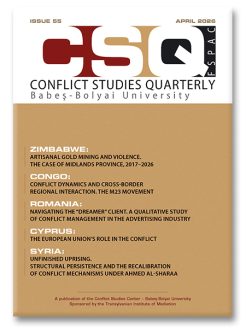
Issue 55 – April 2026
TOPICS: Gold mining and violence, The M23, conflict management, the Cyprus conflict
Coordinator:
Christian Chereji and Ciprian Sandu
Content – Sommaire:

ARTICLES in Issue 55 – April 2026:
Zimbabwe: Artisanal Gold Mining and Violence. The Case of Midlands Province, 2017–2026
Vincent CHENZI, Munyaradzi NYAKUDYA, Enock NDAWANA, & Wilford MUTENDA
Abstract:
This article seeks to unpack the nuances of violence in Zimbabwe’s artisanal gold mining sector and how it impacts the wider community. Drawing on data gathered from Focus Group Discussions (FGDs) and in-depth interviews, the findings indicate that violence in the artisanal gold mining sector is primarily sustained by economic exclusion, a weak regulatory environment, and corrupt security arrangements. To this end, the study utilizes the rational choice model to demonstrate how situational cost–benefit calculations shape the choices of militant actors seeking to profit aggressively from chaos, leading to an upsurge in violence in the gold sector. In this regard, the study argues that economic exclusion and weak regulation create profitable opportunities that are protected by corrupt local security arrangements, resulting in violence, lawlessness, and instability across Zimbabwe’s Midlands gold mining sector. Given the multisectoral nature of this violence, the research concludes by recommending measures aimed at stabilizing the mining sector, thereby diffusing artisanal mining violence.
Keywords:
Artisanal gold mining violence, Midlands province, rational choice model, border porosity, Zimbabwe.
DOI: https://doi.org/10.24193/csq.55.1
Congo: Conflict Dynamics and Cross-Border Regional Interaction. The M23 Movement
Cihan DABAN
Abstract:
One of the most significant problems in the Democratic Republic of the Congo (DRC) is the conflict involving the M23 Movement. This conflict is not merely a national security issue but also constitutes a major challenge at both regional and global levels. The name and continuity of the M23 Movement derive from the claim that the peace agreement signed on March 23, 2009, between the Congolese government and members of the CNDP was not implemented. This date played a decisive role in the group’s adoption of the name “M23 Movement”. The emergence of an armed group such as the M23 Movement in the DRC — one of Africa’s largest countries — provides a critical case for understanding why ongoing conflicts in the country remain unresolved. In this context, the study aims to analyze the conflict between the M23 Movement and the Congolese army within the framework of conflict dynamics and cross-border regional interactions. The theoretical framework draws on conflict dynamics literature to examine how the conflict emerged and why it evolved into a protracted one. In particular, it considers Rwanda’s direct and indirect influence on the M23-Congo conflict within the context of cross-border regional interactions. Methodologically, the study adopts a qualitative case study approach, employing document analysis based on United Nations reports, international news sources, academic literature, and both primary and secondary data. The findings indicate that the M23-Congo conflict cannot be explained solely by domestic factors; rather, cross-border regional actors play a decisive role in sustaining the conflict.
Keywords:
Conflict dynamics, Congo, M23 Movement, Rwanda, national security.
DOI: https://doi.org/10.24193/csq.55.2
Romania: Navigating the “Dreamer” Client. A Qualitative Study of Conflict Management in the Advertising Industry
Anisoara PAVELEA & Alina Diana PASCAL
Abstract:
The advertising industry has transitioned into a highly fragmented and dynamic environment, yet the nature of conflict within agency-client relationships remains under-researched, particularly in transitional markets. While literature extensively covers “success factors,” there is a notable gap in understanding the pragmatic, day-to-day conflict resolution strategies employed by practitioners. This study explores how advertising practitioners in Romania perceive the causes of conflict and identifies the informal practices used to prevent, manage, and resolve these tensions. Specifically, it examines the “expectation-expertise asymmetry” that characterizes modern digital advertising services. Using an exploratory qualitative design, semi-structured interviews were conducted with five Romanian advertising professionals. Data were analyzed using Braun and Clarke’s (2006) thematic analysis framework. Findings reveal five dominant themes: (1) an epistemic gap where execution-level practitioners view academic theory as disconnected from rapid digital shifts; (2) a pervasive “expectation asymmetry” driven by “dreamer” clients seeking instant ROI; (3) the emergence of “technical translation” as a critical relationship-maintenance tool; (4) the proactive use of value-based boundaries to protect agency reputation; and (5) a deliberate shift from creative logic to contractual pragmatism during conflict resolution. The study concludes that conflict stems from role ambiguity and technical knowledge gaps. It identifies the Account Manager as a critical “boundary spanner” and informal mediator. By bridging conflict theory with practitioner-led solutions, this research contributes to a grounded understanding of how professional service relationships are sustained in emerging European markets.
Keywords:
Advertising agency, agency-client relationships, conflict management, account management, Romania, qualitative research, thematic analysis.
DOI: https://doi.org/10.24193/csq.55.3
Cyprus: The European Union’s Role in the Conflict
Laura PIMENTA
Abstract:
This research examines how the European Union has approached the Cyprus conflict, focusing on why it has failed to assume a central role in conflict resolution. While EU accession initially reshaped the dynamics of the dispute, the Union has not succeeded in achieving meaningful progress toward a settlement. Instead, the EU evolved from a potential mediator into a structurally partial stakeholder in the conflict. Drawing on a constructivist framework, complemented by the concept of Normative Power Europe and an institutional perspective, the article analyzes how perceptions, norms, and institutional constraints have shaped the EU’s role in Cyprus. The research adopts a qualitative, document-based case study approach, supported by interviews with experts and members of the Cypriot communities, providing insights into both institutional dynamics and lived experiences. The article concludes that Cyprus’ accession has internalized the conflict within the European Union, reinforcing asymmetries between the two communities and limiting the Union’s capacity to act impartially.
Keywords:
Conflict resolution, Cyprus conflict, EU external action, European Union, Normative Power Europe, United Nations.
DOI: https://doi.org/10.24193/csq.55.4
Syria: Unfinished Uprising. Structural Persistence and the Recalibration of Conflict Mechanisms under Ahmed al-Sharaa
Tuğçe URALER
Abstract:
This study examines the evolving mechanisms that transformed Syria’s 2011 popular uprising into internal conflict, arguing that these dynamics, though reconfigured, persist under the leadership of Ahmed al Sharaa in 2025. Drawing on Adrian Florea’s “Contentious Politics Approach”, the analysis focuses on three interlinked processes: erosion of legitimacy, radicalization, and militarization. The empirical foundation of the study is based on semi-structured interviews conducted with 32 individuals, including civilian actors formerly affiliated with the Syrian National Coalition and military personnel who later served in the Syrian National Army, previously known as the Free Syrian Army. The sample was selected to reflect variation in gender, age, regional origin, professional background, and socio-economic status. Data were analyzed using MAXQDA 24 Analytics Pro, enabling both thematic coding and statistical mapping of participant narratives. The findings reveal how structural conditions, particularly socio-economic exclusion and authoritarian resilience, continue to drive identity politicization, which in turn facilitates radicalization and militarization through sustained regional and global interventions. By situating Syria’s post-uprising trajectory within broader debates on post-conflict reconstruction, rebel victory, and civil conflict, the study contributes to a deeper understanding of how legitimacy crises and external entrenchment perpetuate cycles of instability in fragmented state contexts.
Keywords:
Legitimacy contestation, radicalization, militarization, civil conflict, politicization of identities.
DOI: https://doi.org/10.24193/csq.55.5