
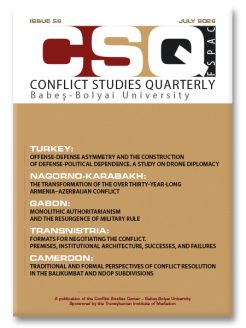
Issue 56 – July 2026
TOPICS: Offence-defence asymmetry, Nagorno-Karabakh, Transnistria negotiation, Conflict resolution
Coordinator:
Christian Chereji and Ciprian Sandu
Content – Sommaire:

ARTICLES in Issue 56 – July 2026:
Turkey: Offense-Defense Asymmetry and the Construction of Defense-Political Dependence. A Study on Drone Diplomacy
Pengpeng CAO
Abstract:
The proliferation of unmanned aerial vehicles (UAVs) has democratized precision-strike capabilities, enabling middle powers to project asymmetric influence. While existing scholarship often attributes Turkey’s burgeoning drone diplomacy to Neo-Ottoman ambitions or opportunistic export promotion, these frameworks primarily address strategic motivations rather than the underlying mechanisms of geopolitical success. This article argues that Turkey leverages the offense-defense asymmetry (ODA) inherent in its combat-proven drones to translate transient tactical battlefield victories into structured defense-political dependence. Employing process tracing and cross-case comparison, the study analyzes three distinct regional arenas. It demonstrates how Turkey’s asymmetric interventions systematically generated an alliance-building network in the Caucasus, a resource-exchange network in Africa, and a conflict-mitigation network in the Middle East. Ultimately, this article concludes that, rather than broadly reconfiguring the macro-level regional order, Turkey has astutely exploited a technological window to alter localized balances of coercion and patterns of defense-market dependence. However, the sustainability of these diplomatic networks remains inherently constrained by significant macroeconomic vulnerabilities and normative limitations.
Keywords:
Turkey, middle power, offense-defense asymmetry (ODA), drone diplomacy, structured dependence, process tracing.
DOI: https://doi.org/10.24193/csq.56.1
Nagorno-Karabakh: The Transformation of the Over Thirty-Year-Long Armenia–Azerbaijan Conflict
Ayşegül GÜLER
Abstract:
The end of the Cold War between the United States and the Soviet Union marked a fundamental transformation in international politics. The South Caucasus, vacated by the Soviets, became one of the centers of international competition. Influenced by the diaspora, Armenia unilaterally declared the annexation of the Karabakh region, legally recognized as Azerbaijani territory, and altered the demographic structure of the region. A long period of violent conflict began in the region. Although ceasefires were established between the two countries, Armenia, supported by the West, sometimes violated these ceasefires. During this period, when the peoples of the world were becoming increasingly economically and socially interdependent and the importance of transnational organizations and institutions was growing, the conflict affected states in different ways. Armenia’s limited economic resources and the increasing cost of continuing the struggle led to the deterioration of the country’s economy and increased Russian influence. This stance resulted in Armenia’s exclusion from the East-West economic corridor. The Second Nagorno-Karabakh War began in the early 2020s when Armenia, claiming the right to use force, conducted operations in Azerbaijani territories outside Karabakh. Ultimately, the war ended in favor of Azerbaijan, and Armenia responded favorably to Azerbaijan’s ceasefire proposal, paving the way for a ceasefire agreement. This study evaluates the steps taken and the outcomes achieved in transforming the issue constructively toward peace after a long and destructive conflict. The importance of post-conflict transformation and its collaborative implementation is also examined.
Keywords:
Nagorno-Karabakh, Armenia, Azerbaijan, ceasefire, conflict transformation.
DOI: https://doi.org/10.24193/csq.56.2
Gabon: Monolithic Authoritarianism and the Resurgence of Military Rule
Robert Kosho NDIYUN, Hassan DANMAMA, & Ricky Munyaradzi MUKONZA
Abstract:
This article examines the transition from civilian authoritarian rule to military governance in Gabon, focusing on the factors that precipitated the 2023 military coup in a country characterized by a long-standing deficit of democratic governance. The study addresses the following question: How did entrenched authoritarianism contribute to the emergence and popular acceptance of military rule in Gabon? Drawing on theories of political transition and governance, the research adopts a qualitative case study approach based on secondary data and employs thematic analysis to explore the interplay among political disenchantment, corruption, and socio-economic challenges in shaping public perceptions of political authority. The findings reveal that widespread dissatisfaction with civilian rule – characterized by corruption, ineffective governance, and weak democratic accountability – created favorable conditions for military intervention. The study further demonstrates that authoritarian leadership fostered public frustration, socio-economic inequalities, political repression, and patronage networks, thereby generating an environment conducive to the coup, which was largely welcomed by segments of the Gabonese population. At the same time, the findings highlight the ambivalence of public attitudes toward military governance, raising questions about the prospects for a sustainable return to civilian democratic rule. The article contributes to governance and political transition scholarship by illuminating the complex dynamics between civilian and military regimes in an African context. It also offers policy recommendations aimed at strengthening democratic institutions, promoting equitable resource distribution, and enhancing democratic resilience to address citizens’ grievances and reduce the appeal of military rule.
Keywords:
Monolithic authoritarianism, civil-military relations, Gabon, military coups, democratisation, governance.
DOI: https://doi.org/10.24193/csq.56.3
Transnistria: Formats for Negotiating the Conflict. Premises, Institutional Architecture, Successes, and Failures
Eugen STRĂUȚIU
Abstract:
Our research aims to clarify the historical context in which the negotiation formats for the Transnistrian conflict were established, the founding documents, their evolution over time as a succession of productive stages and contested interruptions, their successes and failures and the reasons behind them, as well as possible options for correcting past shortcomings or eventually replacing the current formats with more effective ones. In this regard, we examine the “5+2” format, the “1+1” format, and the sectoral working groups. Currently, the first format is no longer functioning, having been suspended since 2022. The other two operate irregularly and have not produced mutually agreed-upon results. Instead, they merely highlight the divergences in the approaches adopted by Chisinau and Tiraspol regarding the main issues on their agenda: Romanian-language schools on the eastern bank of the Dniester; ensuring freedom of movement across the demarcation line; advancing the recognition by Chisinau of school diplomas issued in Tiraspol; implementing a system of license plates for vehicles in Transnistria approved by the government of the Republic of Moldova; and taxing businesses in Transnistria in accordance with the legislation of the Republic of Moldova. The hypotheses we test are as follows: first, that the presence of the Russian Federation in the conflict has been counterproductive, both as a party to the conflict and as a mediator; second, that the Russian-Ukrainian partnership, which until 2022 was systematically manifested to the detriment of the interests of the Republic of Moldova, cannot be resumed under current circumstances; and third, that the existing negotiation formats require reconsideration, whether through maintaining them unchanged, reforming them, or abandoning them altogether.
Keywords:
Transnistrian conflict, negotiation formats, the “5+2” format, the “1+1” format, the sectoral working groups.
DOI: https://doi.org/10.24193/csq.56.4
Cameroon: Traditional and Formal Perspectives of Conflict Resolution in the Balikumbat and Ndop Subdivisions
NKIENE Claude Désiré TINOH
Abstract:
This paper examines traditional and formal conflict resolution mechanisms in the Balikumbat and Ndop subdivisions of Cameroon. Numerous historical, political, economic, and social differences ignited bloody conflicts between Balikumbat and neighboring ethnic groups, with adverse effects on the population. This explains why the use of both traditional and modern mechanisms in resolving these conflicts became imperative, as all available avenues had to be explored. At different periods and before various formal and traditional actors and institutions, diverse mechanisms were employed to resolve inter-village differences, each revealing strengths and weaknesses that had a significant impact on the processes and outcomes. Using a qualitative case study research design, the study selected a sample of 25 people who had been affected by the conflicts or had actively or passively participated in their resolution. Data were collected with the aid of interview guides. Our findings revealed that, while formal approaches, by virtue of their punitive nature, imposed solutions without promoting reconciliation, restorative traditional conflict resolution mechanisms, which were deeply embedded in the customs and ways of life of the people, continued to demonstrate their capacity to offer sustainable solutions to violent disagreements. This research therefore underscores the need to integrate modern and traditional approaches to conflict resolution in a functional juxtaposition that will enrich the actors, institutions, and processes involved and help achieve sustainable outcomes.
Keywords:
Traditional, formal, perspectives, conflict, conflict resolution, integrating.
DOI: https://doi.org/10.24193/csq.56.5