
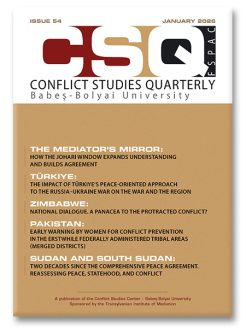
Issue 54 – January 2026
TOPICS: Johari Window, Russia-Ukraine War, protracted conflict, conflict prevention, Comprehensive Peace Agreement
Coordinator:
Christian Chereji and Ciprian Sandu
Content – Sommaire:

ARTICLES in Issue 54 – January 2026:
The Mediator’s Mirror: How the Johari Window Expands Understanding and Builds Agreement
Constantin-Adi GAVRILĂ & Christian-Radu CHEREJI
Abstract:
This paper examines the Johari Window model as a framework for enhancing self-awareness, communication, and understanding in mediation. Developed by Joseph Luft and Harry Ingham (1955), the model divides awareness into four quadrants—Open, Blind, Hidden, and Unknown— each representing different dimensions of how people perceive themselves and others. The study applies this model across all phases of the mediation process: in preparation, it helps mediators map shared and concealed information; in exploration and problem-solving, it facilitates disclosure and feedback to shift from positional bargaining to interest-based negotiation; and in the agreement and evaluation phases, it guides the creation of SMART (Specific, Measurable, Achievable, Relevant, Time-bound) agreements and supports reflection on outcomes and relationships. The paper also considers the ethical, cultural, and power-related challenges of using the Johari Window, highlighting the importance of confidentiality and voluntary disclosure. At the same time, it underscores the model’s value in strengthening mediator self awareness, reducing bias, and promoting ongoing professional learning. Overall, the Johari Window demonstrates why mediation can work where conventional negotiation fails: it turns the process into one of guided awareness, allowing empathy, openness, and genuine understanding to emerge. By helping parties see what is hidden or misunderstood—both in themselves and in each other—mediation creates the conditions for deeper insight and more durable, integrative solutions when negotiation alone cannot achieve them.
Keywords:
Johari Window, mediation, conflict resolution, self-awareness, communication, interest-based negotiation, ethical mediation practice.
DOI: https://doi.org/10.24193/csq.54.1
Türkiye: The Impact of Türkiye’s Peace-oriented Approach to the Russia–Ukraine War on the War and the Region
Ayşegül GÜLER
Abstract:
This article aims to analyze the reasons behind the war initiated by Russia against Ukraine as part of its efforts to re-establish control over its former spheres of influence after 2000 and Türkiye’s initiatives in response to these developments. One of the reasons the war rapidly evolved into a Europe–Russia conflict is Russia’s strong objection to Ukraine’s desire to join the North Atlantic Treaty Organization (NATO). Russia’s stance is a cause of concern for Europe. This study discusses the historical, social, political, and economic dimensions of the Ukraine War and explains the multifaceted nature of its impact. Mediation efforts and diplomatic initiatives are crucial for resolving the ongoing war. As a NATO member capable of maintaining communication with both parties, Türkiye has intensified its efforts to end the war. Despite ongoing mediation efforts and a peaceful approach to the issue, the problem remains unresolved. This study seeks to answer what needs to be done to achieve lasting and sustainable peace in the Russia-Ukraine War and whether Türkiye’s efforts will be sufficient to reach a resolution.
Keywords:
Russia, Ukraine, Türkiye, Europe, Istanbul Agreement, peace talks.
DOI: https://doi.org/10.24193/csq.54.2
Zimbabwe: National dialogue. A Panacea to the Protracted Conflict?
Octavious Chido MASUNDA
Abstract:
National dialogue has emerged across Africa as a contested tool for conflict resolution and governance reform. This article examines Zimbabwe’s case, where cycles of electoral dispute, authoritarian resilience, and failed settlements have perpetuated crises. Based on qualitative interviews with stakeholders from politics, civil society, academia, and faith institutions, the study finds strong consensus that national dialogue must be inclusive, transformative, and nationally owned. Lessons from past initiatives—including the Internal Settlement, Lancaster House Agreement, Unity Accord, the Global Political Agreement, and POLAD—highlight that exclusion, weak enforcement, and partisan convening undermine legitimacy. Respondents envision national dialogue—led reforms in electoral governance, security sector accountability, socio-economic compacts, and social cohesion, yet warn that entrenched mistrust, power imbalances, and authoritarian adaptation remain significant barriers. The paper proposes a framework for context-sensitive national dialogue in Zimbabwe, emphasizing credible facilitation, legal entrenchment, civic education, and regional guarantorship. It concludes that national dialogue offers both promise and peril: a potential catalyst for structural transformation, but equally a risk of entrenching authoritarianism if not institutionally safeguarded—especially in the absence of a strategic hurting stalemate and a fragmented opposition.
Keywords:
Zimbabwe, national dialogue, conflict transformation, authoritarianism, democratic transition, peacebuilding.
DOI: https://doi.org/10.24193/csq.54.3
Pakistan: Early Warning by Women for Conflict Prevention in the Erstwhile Federally Administered Tribal Areas (Merged Districts)
Noreen NASEER, Muhammad Irfan MAHSUD, & Marium FATIMA
Abstract:
This study examines the role of tribal women who issued warnings to elders and community members prior to the outbreak of conflicts in Kurram, Orakzai, and North and South Waziristan, located in the former Federally Administered Tribal Areas (now Merged Districts) of Pakistan. These early warnings demonstrate the efforts of tribal women to prevent emerging conflicts; however, their concerns were largely disregarded by tribal authorities. The article analyzes the status of women within patriarchal tribal structures that marginalized their perspectives and constrained their ability to report latent conflict drivers and early warning signs to stakeholders capable of taking preventive action. Understanding the position of women in tribal societies and their relationship to conflict informs a hypothesis grounded in feminist security theory: conflict and violence in the tribal districts could be mitigated if women were included in both informal and formal mechanisms of conflict prevention and peacebuilding. Drawing on primary and secondary sources, this research evaluates the contributions of tribal women in the pre-conflict stages and highlights their potential role in strengthening early warning and prevention systems.
Keywords:
Tribal Women, Early Warnings, Violence and Peace Building, Merged Districts.
DOI: https://doi.org/10.24193/csq.54.4
Sudan and South Sudan: Two Decades Since the Comprehensive Peace Agreement. Reassessing Peace, Statehood, and Conflict
Ciprian SANDU
Abstract:
This article offers a retrospective assessment of the Comprehensive Peace Agreement (CPA), signed on January 9, 2005, between the National Congress Party (NCP) and the Sudan People’s Liberation Movement/Army (SPLM/A). Twenty years later, the initial hopes of peace, democratization, and development have largely dissipated, replaced by cycles of violence, state collapse, and humanitarian crises in both Sudan and South Sudan. Drawing from previous research and updated conflict analysis, the article explores the causes of regression, the limitations of separatism as a conflict resolution tool, and the regional implications of failing peace agreements.
Keywords:
Comprehensive Peace Agreement, Sudan, South Sudan, separatism, conflict resolution, state failure, CPA+20.
DOI: https://doi.org/10.24193/csq.54.5